Sedation dentistry is generally safe, and the numbers support that. In a review of 690 dental sedation cases, the most common adverse event was vomiting at 1.3% of sedations, and every other recorded event fell below 1%. The answer gets more useful once you know there are four levels, minimal sedation, moderate sedation, deep sedation and general anesthesia, because the level chosen changes your risk more than the drug does.
People who type "is sedation dentistry safe" into a search bar aren't really asking about a pill. They're asking three quieter questions. Will I stop breathing? Will anyone notice if I do? And will I wake up properly afterward? Those questions have answers, and none of them are yes or no.
Safety in sedation is a process, built in order, before, during and after your appointment. Here's how that process works, what the published complication rates look like, and which parts of your own health history change the plan.
Is Sedation Dentistry Safe? The Short Answer
For most healthy adults, yes. Sedation dentistry is safe when a trained dentist screens you beforehand, monitors you throughout treatment, and keeps you in recovery until you meet set discharge criteria. The drug gets the headlines. The depth you're taken to, and the monitoring that comes with that depth, does more of the actual work.
The four levels, in plain language
Think of sedation as a dial, not a switch. At the light end you're awake and chatting. At the deep end your airway may need help.
- Minimal sedation. You're relaxed and fully awake, and you answer questions normally. Inhaled nitrous oxide on its own usually sits here.
- Moderate sedation. You respond purposefully to your name or a light touch, and you keep breathing on your own without help. Oral sedative pills and IV sedation commonly reach this level.
- Deep sedation. You respond only after repeated or painful stimulation, and your airway may need support to stay open.
- General anesthesia. You can't be easily roused and you don't respond purposefully at all. This is operating-room level care.
| Sedation level | How the patient responds | Monitoring expected | Typical use |
|---|---|---|---|
| Minimal sedation | Relaxed and awake, answers normally to verbal commands | Pulse oximetry and vital signs | Mild anxiety and routine visits |
| Moderate sedation | Purposeful response to voice or light touch, breathing stays independent | Continuous pulse oximetry and a trained observer | Longer procedures and moderate anxiety |
| Deep sedation | Responds only after repeated stimulation, airway may need support | Continuous monitoring by trained staff with rescue equipment ready | Complex or lengthy treatment in specialized settings |
| General anesthesia | Cannot be easily roused, no purposeful response | Full monitoring by an anesthesia provider | Extensive surgery and some special-needs cases |
Delivery works three main ways. Nitrous oxide is a gas breathed through a small nasal mask. Oral sedation is a pill taken before your appointment. Intravenous sedation goes through a thin needle in a vein. Each method reaches a different depth on that dial, and the monitoring climbs with it, from pulse oximetry and vital signs at the light end to continuous observation with rescue equipment at the deep end.
The lightest level that keeps you comfortable generally carries the fewest risks. That's the whole principle, and it's why the first question to ask your dentist isn't "which drug" but "which level, and why that one for this procedure." If anxiety is what's kept you out of the chair, our guide on how to overcome dental anxiety covers what helps before sedation even enters the conversation.
Sedation Risks and How Often They Happen
A complication during sedation is uncommon. Uncommon isn't the same as impossible, and the honest version of this answer means showing you real event rates instead of promising you a zero.
That's what a 2022 peer-reviewed retrospective study of 690 dental sedation cases did. Reviewers counted 28 adverse events in total across those 690 sedations.
| Event | Cases | Share of sedations |
|---|---|---|
| Vomiting | 9 | 1.3% |
| Oversedation | 6 | 0.9% |
| Blood-pressure fluctuation | 3 | 0.4% |
| Low oxygen saturation | 3 | 0.4% |
| Excessive respiratory secretions | 2 | 0.3% |
| Hypothermia | 2 | 0.3% |
| Allergy | 1 | 0.1% |
| Partial laryngospasm | 1 | 0.1% |
| Transient ST-segment elevation | 1 | 0.1% |
| All respiratory adverse events | About 5 | 0.7% |
| All cardiovascular events | 4 | 0.6% |
| Agitation (not a medical complication) | About 328 | 47.5% |
| Total adverse events | 28 | About 4.1% |
What each row actually means
Vomiting was the most frequent event, in 9 cases. Next came oversedation, where the patient went deeper than intended, in 6 cases. Blood-pressure fluctuation and low oxygen saturation each appeared 3 times. The tail end of the list, excessive secretions, hypothermia, allergy, partial laryngospasm and a temporary heart-tracing change, each showed up once or twice.
Grouped by body system, respiratory events occurred in 0.7% of cases and cardiovascular events in 0.6%. These are the categories that matter most, because they're the ones a trained team is watching for with a pulse oximeter, a blood pressure cuff and their own eyes.
Agitation deserves its own line, and it's the number often misread. It was documented in 47.5% of sedations, but it is a behavior, not a medical complication. Roughly a third of those episodes, 34.1%, led the dentist to pause treatment. That's a scheduling and comfort problem, not a breathing problem.
Where these numbers stop applying
The study was retrospective and drawn from a single setting. Treat those percentages as a description of one reviewed population, not a universal rate for every practice, every patient or every sedation level. A child going under deep sedation is not the same risk profile as an adult breathing nitrous oxide for a filling.
That difference shows up clearly in a 2025 study of 504 pediatric dental patients receiving deep sedation in BMC Oral Health, which reported hypoxemia in 10.3% of patients, bradycardia in 1.8% and tachycardia in 2.0%. Deep sedation is a deeper level than most routine visits ever reach, so those rates describe a higher-risk setting with closer monitoring built around it.
Nitrous Oxide, Oral and IV Sedation Compared
Three methods, three different risk profiles, and the right one depends on your procedure, your health history and how much you want to remember.
Inhaled nitrous oxide is the lightest option and the easiest to reverse. You breathe it through a nasal mask, stay awake and responsive the whole time, and the effect fades within minutes of the mask coming off. That fast off-switch is why it carries the lowest risk of the three, and why you can often drive yourself home afterward. It suits mild anxiety and shorter visits.
Oral sedative pills are taken before your appointment, which is both their convenience and their limitation. Once a pill is swallowed and absorbed, nobody can dial the depth back down. The dose has to be set in advance, it must account for everything else you take, and you'll need an adult escort plus a longer recovery window. Expect to clear the rest of your day.
Intravenous sedation goes through a small needle in a vein, so the depth can be adjusted minute by minute while treatment is underway. That control is why IV sedation pairs with continuous monitoring and a trained observer whose only task is watching you.
What the comparison studies show
A 2024 analysis of 1,260 third-molar surgery patients in Scientific Reports found that both general anesthesia and intravenous sedation maintained satisfactory oxygen saturation, while the IV sedation group had a lower incidence of intraoperative hypotension, meaning fewer drops in blood pressure during surgery.
That study covered surgical tooth extractions, not routine cleanings, so it doesn't set a rate for every procedure. What it does show is that the method and the monitoring travel together, and that a well-managed IV case can hold steadier vital signs than a deeper alternative.
The rule to carry out of this section: a method is only as safe as the monitoring it comes with. Nitrous oxide without a pulse oximeter and a trained eye isn't automatically gentler than IV sedation with both.
Ask which method fits your procedure and why that one, then ask what monitoring comes attached to it. A practice that can answer both without reaching for a brochure is a practice that has thought it through.
Screening Steps and the Health Factors That Change Your Plan
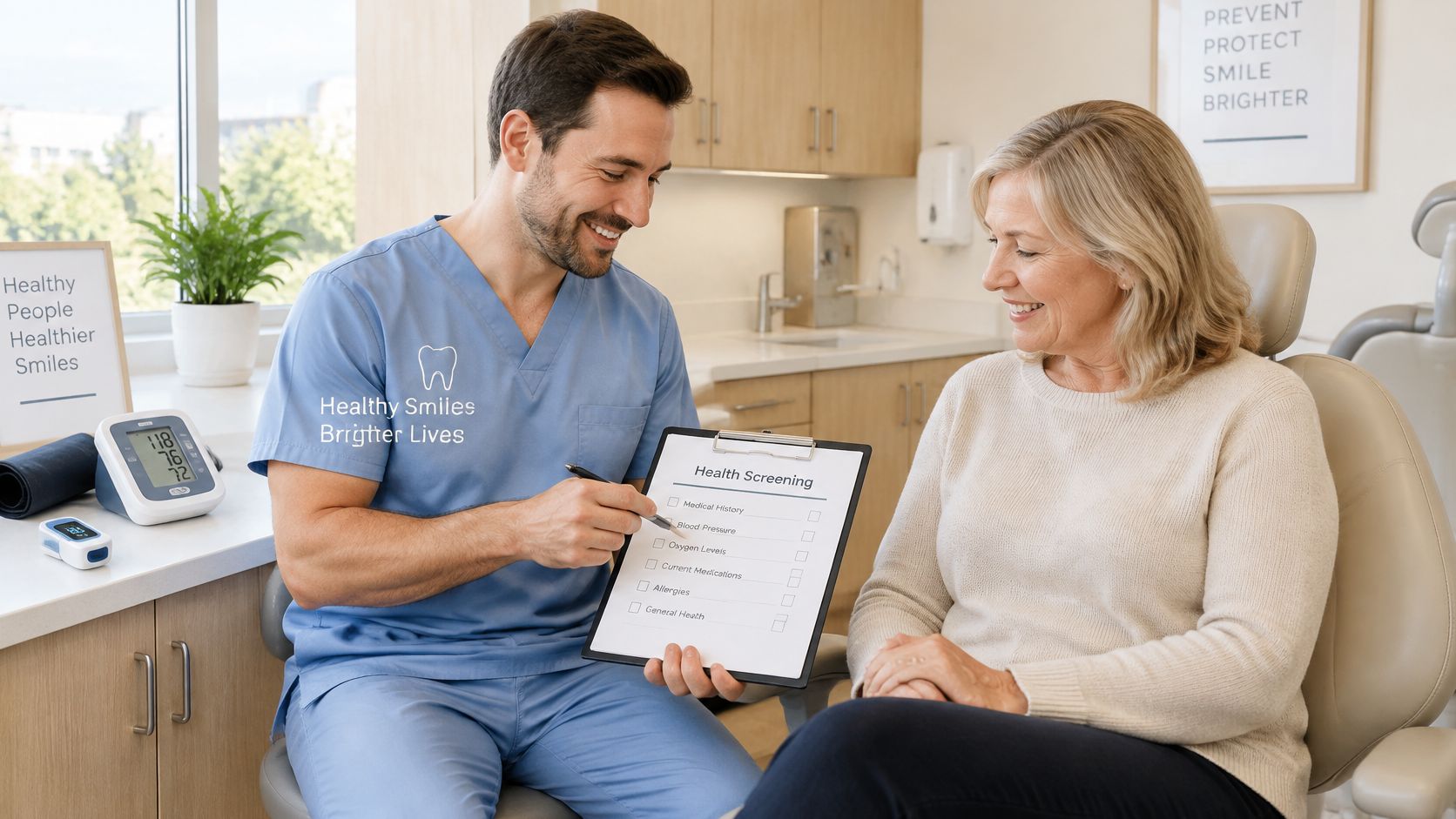
A sedation plan is only as safe as the information behind it, which is why screening happens before any medicine is measured out. The presedation evaluation works like a pre-flight checklist: nothing proceeds until every item is confirmed. The guidelines jointly issued by the American Academy of Pediatrics and the American Academy of Pediatric Dentistry, archived by the Maine Board of Dental Practice describe that evaluation in concrete terms: review the medical and dental history, identify conditions that raise sedation risk, and perform a focused airway examination when appropriate.
Six screening steps, in order
- Review your medical and dental history, including past surgeries and any previous reaction to anesthesia or sedation. A reaction that happened once can happen again.
- Record every medication with its dose, covering prescriptions, over-the-counter products and supplements. Vague answers here are the single most common gap in a screening.
- Examine the airway when appropriate, looking for enlarged tonsils or anatomical features that could make the airway harder to keep open once your muscles relax.
- Confirm fasting for elective treatment. When urgent care rules fasting out, the team weighs how pressing the problem is against how deep the sedation needs to go.
- Choose the technique and depth that fit your risk profile. Two patients booked for the same procedure can safely need different levels of sedation, because their health histories differ.
- Put the plan in writing, so you know the level of sedation, the monitoring, the escort rules and the recovery expectations before the day arrives.
At The Dental Retreat, the team reviews each patient's oral health history, aesthetic preferences, and any concerns or anxieties from the first consultation onward. That first conversation is where most of these six steps get answered.
Which conditions change the plan
Some health factors raise the stakes more than others. Each row below shows what a condition changes and exactly what to say at your screening visit.
| Factor | Why it matters | What to tell your dentist |
|---|---|---|
| Enlarged tonsils or airway anatomy | Narrower airway can be harder to keep open under sedation | Describe any airway concerns or noisy breathing |
| Sleep apnea or loud snoring with breathing pauses | Sedation can reduce breathing drive further | Report pauses in breathing during sleep |
| Lung disease | Less oxygen reserve during sedation | Name the condition and all inhalers used |
| Heart or blood-pressure conditions | Blood pressure and heart rate can shift during treatment | List conditions and heart or blood-pressure medicines |
| Prescribed sedatives or sleep medicines | Combined effects can deepen sedation | Bring the full list with doses and timing |
| Opioid pain medicines | Can add to breathing suppression | List every opioid taken, including recent doses |
| Alcohol or recreational drugs | Can increase sedation depth unpredictably | Disclose use honestly before treatment |
| Antihistamines | Adds drowsiness | Name the product and how often it is taken |
| Age (children or older adults) | Needs dose adjustment and closer monitoring | Share age-related health history |
| Past anesthesia or sedation problems | A previous reaction may repeat | Describe what happened and when |
Combinations matter more than any single pill. A prescribed sedative layered with an opioid, a sleep aid, an antihistamine or alcohol can suppress breathing further than either would alone. That is why "tell your dentist about medications" appears on every instruction sheet, and why a complete list with doses protects you far better than a partial one.
Some patients need extra caution even at light levels of sedation. New Brunswick's 2025 dental sedation guidance singles out children, elderly patients, medically compromised patients and people already taking prescribed sedative medicines as groups needing dose adjustment so that minimal sedation is not exceeded by accident, and it strongly recommends continuous pulse oximetry for them before, during and after treatment.
Screening cannot remove every risk, and no honest provider will claim it can. What it does is let the team choose a safer plan and stage the right equipment before you ever sit in the chair. That preparation is often the difference between a brief pause in treatment and a true emergency.
How Your Care Team Monitors You During Treatment
Monitoring isn't a machine beeping in the corner. It's a person, plus equipment, watching specific things in a specific order. The American Dental Association's sedation guidelines frame it as continuous assessment, with a qualified dentist or trained person staying in the operatory until recovery criteria are met.
What the team is watching, and when
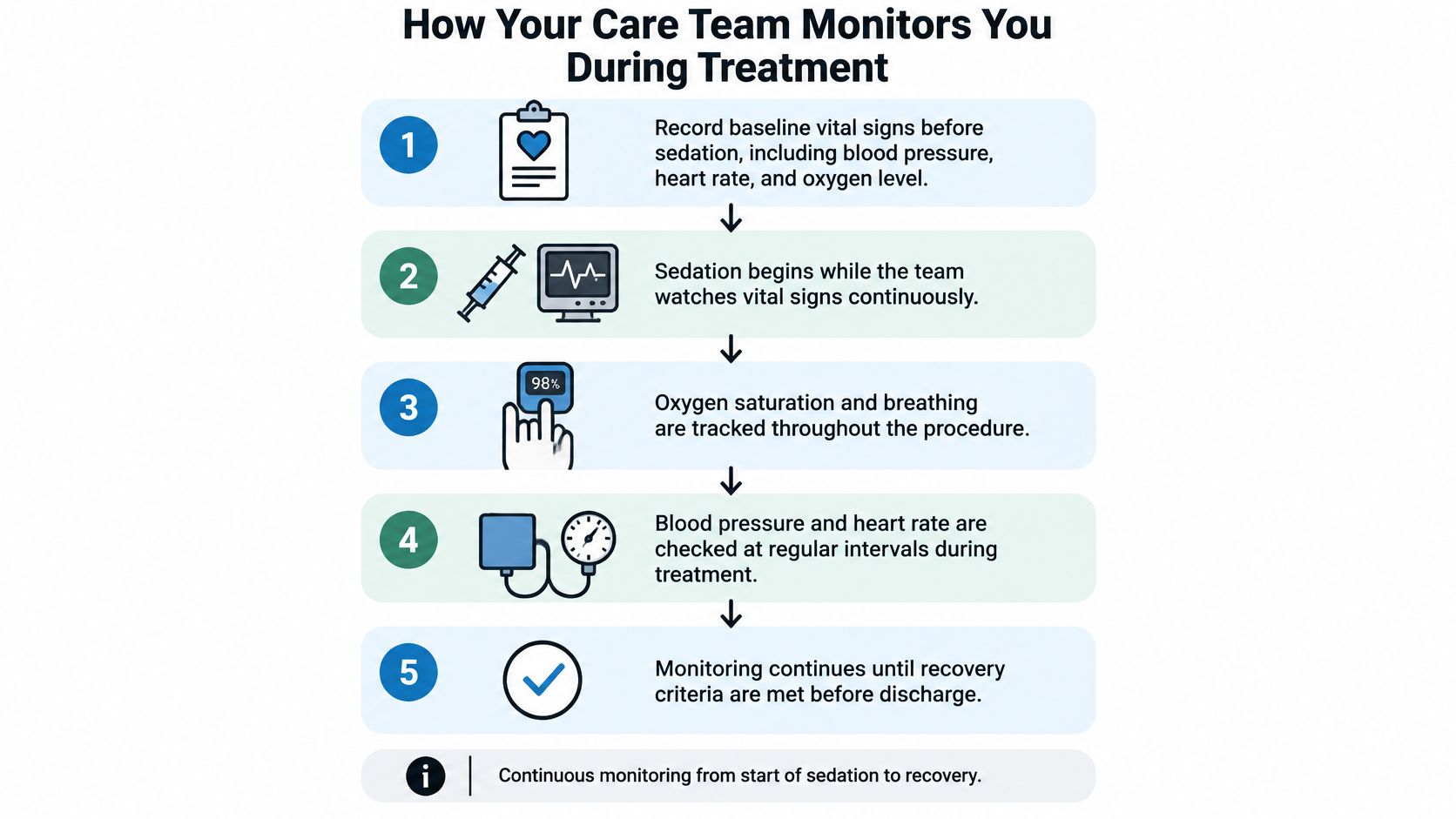
It starts with baseline vitals before anything is given, blood pressure, heart rate and oxygen saturation, plus a check of how alert you are and how you respond to your name. You can't spot a change later if nobody wrote down the starting point.
Then sedation begins, and four things get tracked. Consciousness, by asking you to respond to verbal commands. Oxygenation, usually with a pulse oximeter clipped to a finger. Ventilation, by watching chest movement and confirming you're breathing. Circulation, including blood pressure and heart rate before, during and after treatment when clinically appropriate. Alertness gets reassessed at intervals, especially once the procedure ends.
For children and anyone needing closer observation, breathing is also tracked with expired carbon dioxide monitoring, and airway equipment is sized to the patient rather than borrowed from an adult drawer. Any event, an oxygen drop, an airway intervention, a reversal agent, gets written down.
This short walkthrough shows the same sequence in motion, from baseline through recovery.
The equipment that should be in the room
ADA educational guidance states that any location using sedation should have written emergency protocols, suction, physiologic-monitoring equipment, positive-pressure oxygen equipment suitable for the patient, and emergency drugs. Not equipment somewhere down the hall. In the room.
Ask this before your appointment: "Who will be watching me, what will they be watching, and where is the emergency equipment kept?" A confident, specific answer tells you a great deal.
Those standards don't make sedation risk-free. They're the reason it's manageable, because they assume something can go wrong and build the response in advance. Screening gets you a safe plan. Monitoring is what keeps the plan safe while it's running.
Recovery, Discharge and Going Home Safely
Finishing the procedure is not the same as being ready to leave. Discharge happens when vital signs are stable, you've returned to your presedation level of alertness, and predetermined recovery criteria are met. Not when the chair is needed for the next patient.
The recovery window is the part patients underestimate. Sedatives can reduce breathing drive and airway muscle tone, and residual drug effects persist after treatment ends. AAPD sedation guidance specifies recovery to the presedation level of consciousness before discharge, physiologic monitoring during and after treatment, age- and size-appropriate airway equipment, trained personnel capable of airway rescue, and reversal medications when applicable. In pediatric protocols, oxygen saturation, heart rate, respiratory rate, blood pressure, level of consciousness and expired carbon dioxide are all documented, with continuous oximetry and heart rate monitoring while the patient is less than fully alert.
Our guide on how to prepare for sedation dentistry walks through the day-before details, from fasting timing to what to bring.
The home checklist for the day of treatment
- Arrange an adult escort before the appointment, not after. Some offices will reschedule without one.
- Skip driving, machinery, contracts and major decisions for the period your clinician specifies.
- Follow fasting and medication instructions exactly, including when to restart your usual medicines.
- Start with sips and light food once the team confirms it's appropriate.
- Stay with someone who can notice changes in breathing, skin colour, responsiveness or confusion.
- Know who to call, and know when to skip the call and seek emergency care instead.
Those last triggers are worth saying out loud. Breathing that becomes difficult, a patient who can't be woken normally, or unusual confusion after sedation are reasons to get medical help rather than wait for morning.
Practical rule: ask the office for its written discharge criteria and its after-hours number before the appointment, not while you're groggy in the parking lot.
Book a Sedation Consultation in Katy, TX
The fear underneath most sedation questions isn't pain. It's losing control, and not knowing who's holding the wheel while you're not. That fear is reasonable, and the way to answer it isn't reassurance. It's a plan you've read before any medicine is given.
A consultation at a Katy, TX dental practice is where that plan gets built. The Dental Retreat offers sedation options for patients who experience dental anxiety, and the conversation covers your health history, the procedure, the level proposed, the monitoring attached to it and the discharge rules, all before the day of treatment. Saturday visits are by appointment only, and patients can schedule a personalized consultation to work through it without pressure.
Come with these five questions written down.
- Which sedation level is recommended, and why that one for this procedure rather than a lighter or deeper option.
- Who will monitor me, and what equipment is in the room while it happens.
- What the emergency protocol covers, including oxygen, suction and reversal medications.
- What recovery criteria must be met before I'm discharged.
- What escort and driving rules apply, and for how long afterward.
Bring the medication list from the screening section with doses and timing, a summary of any past anesthesia or sedation experience, and anything about your sleep or breathing that worried you. Patients from Katy and the surrounding neighborhoods, including Sunterra, Cane Island, Katy Manor, Kingscrossing, Lakehouse, Marisol, The Grange, Anniston, Katy Lakes, Elyson and Ventanna Lakes, are all welcome to call or request a visit.
The Dental Retreat offers sedation options for patients who experience dental anxiety, and every sedation plan starts with a conversation about your health history, your procedure and how much relaxation you want. You'll leave a consultation knowing which level is proposed, who will be watching you during treatment, what has to happen before you go home and who to call afterward. Call The Dental Retreat or request a consultation online at The Dental Retreat and get your sedation plan in writing before your next visit.