Your teenager starts covering their mouth in family photos. When you ask about it, they point to a crowded front tooth, then ask whether they really need braces. When considering a dentist near me in Katy, TX, you're probably balancing that concern with practical questions: Will trays work? How long will treatment take? And what happens if your teen forgets to wear them?
Clear Aligners for Teens in Katy TX
Clear aligners for teens are removable, transparent trays that guide teeth through a planned sequence of movements. They're a legitimate orthodontic treatment, not a cosmetic cover for crooked teeth. Each tray is shaped to move selected teeth toward a healthier, better-aligned bite.
Say your teenager wants straighter front teeth but worries about visible brackets during school presentations. Aligners may fit that preference, provided the bite is suitable and the daily routine is workable. Appearance matters, but it can't be the only reason for choosing an appliance.
A decision you make with your teenager
The central question isn't whether your teen is responsible enough to deserve aligners. It's whether a removable appliance matches their clinical needs and everyday life. A student managing lunch, band practice, sports and homework needs a realistic plan, not another reason to feel criticized.
The usual wear benchmark is approximately 20–22 hours daily, with removal mainly for meals, drinks other than water and oral hygiene, as described in Invisalign's teen treatment guidance. The prescribed schedule matters more than how discreet the trays look.
A family conversation helps put the teenager's preferences alongside the parent's practical concerns.

At The Dental Retreat, we provide patient-centered dental care for families in Katy, TX, including Sunterra, Cane Island, Katy Manor, Kingscrossing, Lakehouse, Marisol, The Grange, Anniston, Katy Lakes, Elyson and Ventanna Lakes.
A useful starting point: Choose the treatment your teenager can realistically follow and the clinician can predictably supervise, not simply the appliance that looks easiest.
A good evaluation connects the teenager's goals with their bite, growth stage and willingness to manage removable trays. That's how families get a recommendation that makes sense beyond the treatment preview.
How Teen Clear Aligners Compare to Braces
Adolescent studies suggest aligners can achieve comparable results with shorter treatment in selected cases, but the averages aren't a promised finish date for an individual teenager.
Clear aligners versus braces for teenagers
| Measure | Clear aligners | Braces |
|---|---|---|
| Average treatment time, Class II adolescents | 20.0 ± 11.6 months | 27.4 ± 9.1 months |
| Time to correct the Class II bite | 13.3 ± 10.0 months | 17.4 ± 9.0 months |
| In-office visits during treatment | 12.7 ± 6.2 visits | 17.8 ± 5.8 visits |
| Overall result quality, PAR index | Comparable reduction | Comparable reduction |
| Treatment time in a 72-patient study of 13-year-olds | 24 ± 6 months | 27 ± 5 months |
| Plaque and gum inflammation | Lower in a 50-patient randomized trial | Higher in the comparison group |
| Planned tooth movement achieved | 48.7%–61.1% in one analysis; additional correction may be needed | No corresponding percentage reported |
| Food restrictions during treatment | Trays come out for meals; no bracket-related restrictions | Limit hard, sticky and chewy foods |
| What success depends on | Prescribed near-full-time wear and progress checks | Adjustment visits, appliance care and prescribed elastic wear |
| Visibility | Clear trays are less noticeable; attachments may show | Brackets and wires remain visible |
The Class II treatment-duration, bite-correction, visit and PAR comparisons above come from a 2024 comparative adolescent study: average treatment was 20.0 ± 11.6 months versus 27.4 ± 9.1 months, approximately 7.4 months shorter, with 12.7 versus 17.8 visits, roughly five fewer appointments. The study also reported bite-correction times of 13.3 ± 10.0 versus 17.4 ± 9.0 months, while overall PAR score reductions were comparable.
The additional adolescent treatment-time, hygiene and movement-predictability figures come from a systematic review discussed under the oral-health benefits below. They describe different groups and measures, so they shouldn't be combined into a single prediction for your child.
What those averages actually mean
Class II malocclusion describes a bite relationship in which the upper and lower back teeth don't meet as expected, often alongside upper front teeth that project farther forward. The Peer Assessment Rating, or PAR index, scores how far the bite is from an ideal arrangement. Comparable score reductions mean both groups improved similarly on that measure, not that every tooth moved identically.
The spread around the average treatment times is important. Some teenagers need substantially more correction than others, and treatment plans may include elastics, attachments or additional trays.
The movement-predictability percentage also needs careful interpretation. It isn't the percentage of patients who succeeded, and it doesn't mean that the remaining patients received no benefit. It describes how much planned movement was achieved in an included analysis before any necessary adjustments.
The convenience trade-off
Braces stay attached, so a teenager can't leave the main appliance in a lunchbox. They still require careful cleaning, attendance and cooperation with any prescribed elastics.
Aligners make eating and cleaning more straightforward, but the teenager must repeatedly remove, store and replace them. A shorter average course is only useful when the appliance fits both the bite and the patient's routine.
Our detailed comparison of clear aligners and traditional braces explains those daily differences. Suitability comes before speed when choosing between them.
Which Teens Are Good Candidates for Aligners
An adolescent evaluation separates tooth-position problems from growth-dependent or complex problems. Closing a modest gap isn't the same task as correcting a substantial mismatch between the jaws.
A peer-reviewed adolescent comparison found comparable overall effectiveness for aligners and fixed appliances in teenagers with mild malocclusions. That supports thoughtful case selection, not a claim that trays can handle every bite.
The distinction is easier to understand visually.
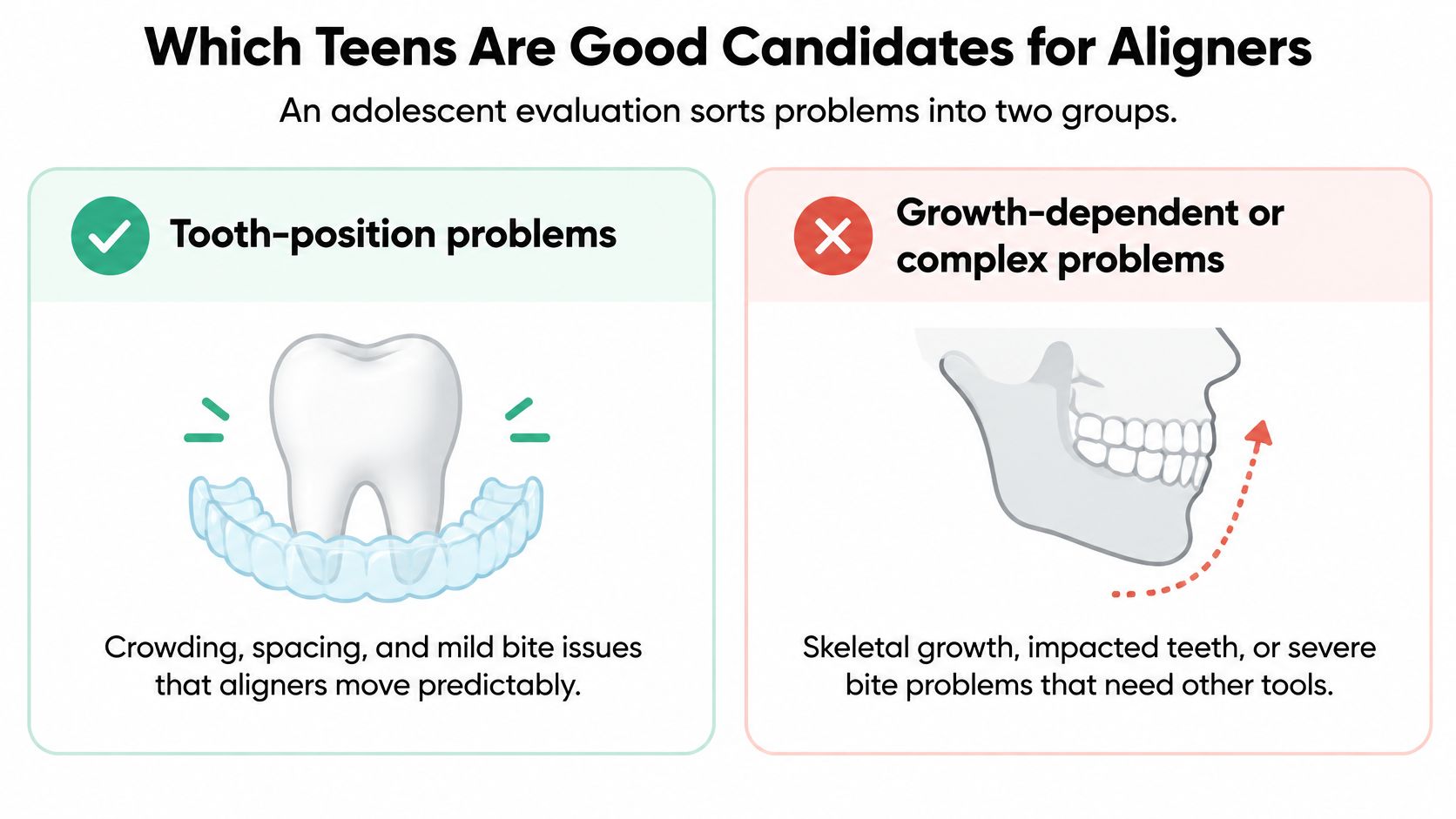
Orthodontic problems and aligner suitability in teenagers
| Orthodontic problem | Aligner outlook for a teen | What may be needed instead |
|---|---|---|
| Mild to moderate crowding | Often a good candidate after assessment | Aligners alone may be sufficient |
| Spacing between teeth | Often suitable when the bite and roots allow | Aligners alone may be sufficient |
| Anterior crossbite | Promising for selected tooth-position problems | Aligners, sometimes with auxiliaries |
| Narrow arch needing expansion | Moderate success; careful treatment design matters | Aligners with close monitoring or another expansion appliance |
| Deep overbite | Planned correction may be only partly achieved | Aligners plus auxiliaries or fixed appliances |
| Severe crowding needing extractions | More demanding and less predictable | Braces, or aligners with planned extraction mechanics |
| Impacted canine | Trays alone aren't a predictable solution | Fixed appliances and possible surgical exposure |
| Skeletal Class II or Class III jaw discrepancy | Growth-dependent; evidence remains uncertain | Functional appliances, braces and growth monitoring |
| Substantial tooth rotations | Additional control is often necessary | Attachments, auxiliaries or fixed braces |
| Mixed dentition with teeth still erupting | Tooth eruption changes sequencing | A staged plan or delayed start |
A 2025 systematic review of adolescent interceptive treatment reported approximately 3.0–3.5 millimeters of average transverse expansion, but extremely high variation between studies limits how confidently that average predicts an individual outcome. Expansion isn't just a matter of ordering wider trays.
For deep bites, a 2024 retrospective analysis of 102 patients aged 10–17 found that treatment achieved an average of 41.38% of the predicted deep-overbite reduction. That's a reason to discuss additional correction early, not to assume every deep bite rules out aligners.
Why growth and eruption change the plan
A growing jaw can change how the teeth meet while treatment is underway. Second molars that haven't fully erupted may also affect tray fit and the order of movements. Dental X-rays help the clinician assess roots, unerupted teeth and obstacles that a surface scan can't establish on its own.
A systematic review of growing patients found inconsistent evidence for skeletal effects and Class II correction. Aligners move teeth, but they shouldn't be presented as a universal solution for changing jaw growth.
An escalation plan is normal clinical planning. It should explain when attachments, elastics, another appliance or fixed braces might become necessary.
Before agreeing to treatment, ask:
- What are we correcting? Is this mainly tooth position, a jaw relationship, or both?
- What could change the plan? How will growth or erupting teeth affect the sequence?
- What happens if movement falls behind? Which adjustments are included, and when would another appliance be preferable?
What Treatment Looks Like From the First Scan to the Retainer
Treatment should feel understandable before the first tray arrives. Parents need clarity about the estimate and appointments; teenagers need to know what will happen in their mouth and what they'll manage themselves.
The overall process follows a progression from assessment to active movement and retention.
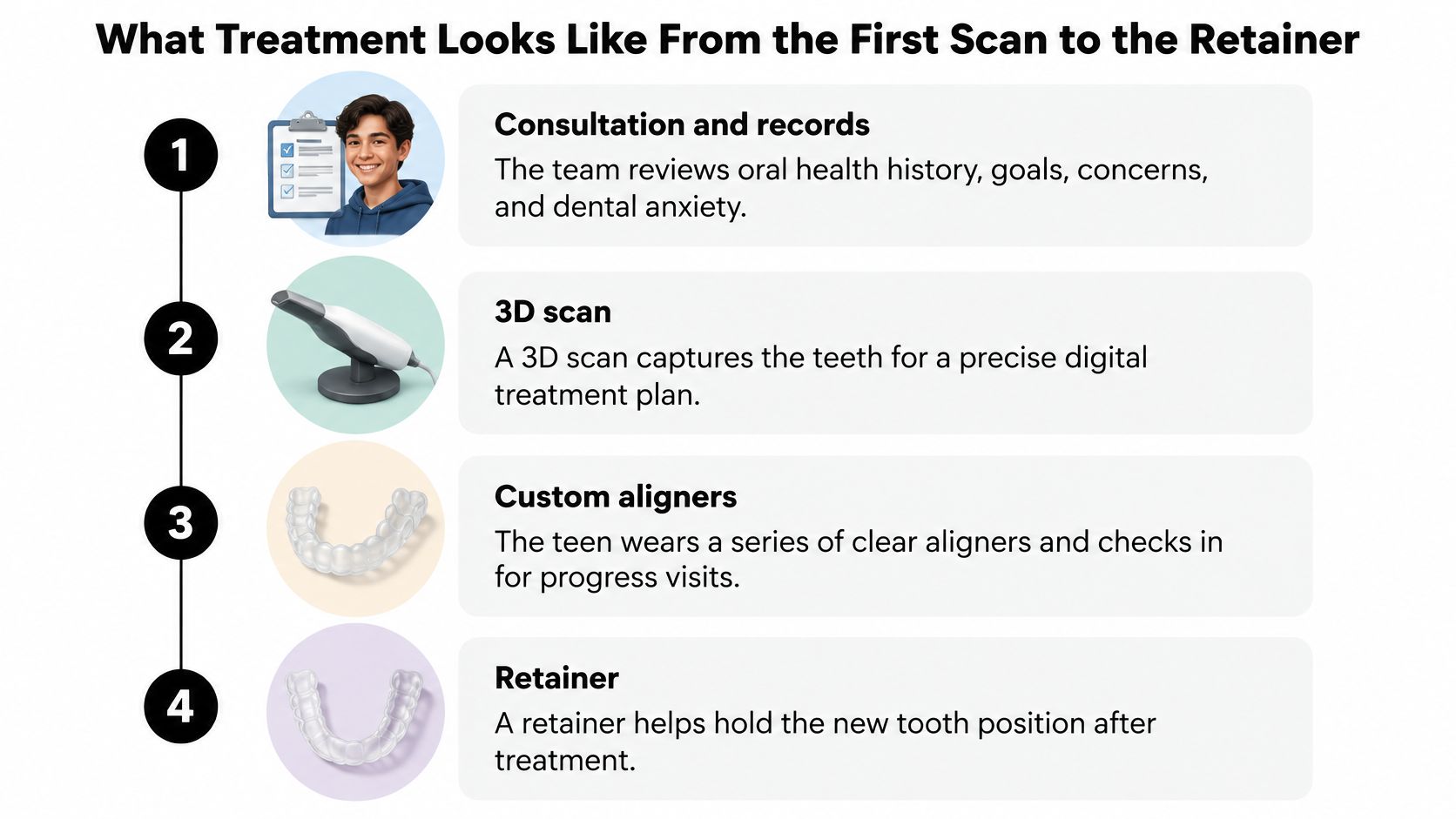
Planning and getting comfortable
Consultation and records. At The Dental Retreat, we review oral health history, aesthetic preferences, concerns and dental anxiety from the first consultation onward. We use 3D imaging to create customized plans suited to each patient's anatomy, alongside the examination and other records needed to assess the bite.
The plan and written estimate. Before committing, review the proposed movements, attachments, estimated treatment duration and approach to refinements. The written estimate should identify whether attachments, replacement or refinement trays, and retainers are included, rather than leaving families to assume everything is covered.
Fitting and practice. If the plan calls for tooth-colored attachments, the clinician bonds these small shapes to selected teeth to help the trays grip and direct movement. The teenager should practice inserting and removing the trays before leaving, especially around attachments that make removal feel unfamiliar.
Insurance coverage is specific to the policy. Bring your orthodontic benefit information so coverage, exclusions and any age limits can be checked before fitting. We offer flexible financing options, and the terms should be understood alongside the treatment estimate.
Active treatment and keeping the result
Daily wear and tray changes. Remove trays for eating, drinks other than water, and cleaning, then follow the prescribed wear schedule. Advance to another tray only on the clinician's instructions; a calendar reminder doesn't establish that the teeth are ready.
Progress reviews. The clinician checks tray seating, attachments, tooth eruption, gum health and whether the planned movements are tracking. Review intervals should reflect the case rather than a universal appointment timetable.
Refinement when needed. If teeth don't reach the planned positions, the clinician may take updated records and order another series. Refinement isn't necessarily a short finishing step, so discuss its possible effect on duration and cost.
Retention. A retainer helps maintain the new tooth positions after active treatment. Follow the prescribed retention schedule, and contact the team if the retainer stops fitting rather than forcing it into place.
A digital animation is a treatment proposal, not proof that each movement has already been achieved. Clinical reviews connect the preview to what's happening in the mouth.
This video provides another way to become familiar with aligner treatment.
Ask for an estimated completion window and the reasons it might change, not a guaranteed finish date for a school event.
The most useful timeline is the one based on your teenager's records. Complex bite correction, interrupted wear and additional refinement can all extend it; the team should explain which of these is most relevant before treatment starts.
The Daily Wear Habit That Decides the Result
The FDA's clear dental aligner guidance advises at least 20 hours of daily wear, or the prescribing professional's instructions, and warns that treatment may not progress as intended without directed wear. It also states that direct-to-consumer aligners without a prescription and dentist or orthodontist supervision aren't authorized.
The adherence figures deserve equal attention: in a retrospective cohort of 2,644 teen and adult aligner patients, 45.5% met the study's full-compliance definition of wearing every aligner for 22 hours daily, 17.2% deviated on 0.1%–25% of their aligners, and 11.6% fell into the next reported compliance category. Classification also involved consistent application-based self-reporting, so these aren't objective measurements of every patient's actual wear.
Missed wear is a treatment problem, not a character judgment
Trays deliver their intended force while seated over the teeth. When wear falls short, teeth can lag behind the programmed sequence, making the next tray fit poorly. Repeatedly advancing despite a poor fit can increase the mismatch.
At home, look for a persistent gap between the tray and a tooth, trays that dislodge during speech, or trays repeatedly left on a counter. These are reasons to contact the team, not proof that your teenager is being dishonest. A loose tray can also reflect a fit or attachment problem.
Real teenage situations and what to do about the trays
| Situation | What to do | Why it matters |
|---|---|---|
| School lunch | Remove and rinse trays, store them in a case, then brush or rinse before reinserting | Napkins make trays easy to discard accidentally |
| Sports practice or game | Follow the clinician's mouthguard plan; reinsert trays promptly after removal | Aligners aren't a substitute for sports protection |
| Sleepover or travel | Pack the case, approved cleaning supplies and a phone reminder | Keeps the routine workable away from home |
| Lost tray | Contact the practice promptly; don't jump ahead without instructions | The clinician must decide which tray safely maintains progress |
| Tray feels loose or drops out | Report the problem promptly, particularly after interrupted wear | Fit, attachment loss and tracking need assessment |
| Cracked or warped tray | Stop using the damaged tray and request instructions | A distorted tray may not apply the intended force |
| Teen consistently refuses wear | Discuss the barriers and whether fixed braces would be more predictable | A workable treatment matters more than appliance preference |
For cleaning and storage routines, use our guide to caring for teeth during clear aligner treatment.
Make honesty easier
A 2025 scoping review of adolescent removable-appliance adherence found limited, variable evidence and no included studies directly assessing clear-aligner adherence in adolescents. Families shouldn't treat adult or mixed-age compliance findings as a precise forecast for their teenager.
Practical rule: Ask what made wear difficult today before asking how many hours were missed.
Combine a simple routine with clinical fit checks. If removable treatment repeatedly doesn't work, changing appliances is a clinical adjustment, not a punishment.
What Improves Besides the Look of the Smile
Easier access for cleaning is one of the clearest practical advantages of removable trays. Teenagers can brush and floss without working around brackets, although taking the trays out doesn't automatically mean they're cleaning well.
A systematic review of clear aligners in growing patients included a 12-month randomized trial of 50 patients aged 10–18 in which the aligner group had lower plaque levels and less gingival inflammation than the fixed-bracket group. The same review reported the separate 72-patient adolescent treatment-time comparison of 24 ± 6 versus 27 ± 5 months and 48.7%–61.1% movement predictability summarized in the comparison table.
Benefits that matter during an ordinary school day
Some teenagers value being able to smile during presentations, video calls or school photos without prominent brackets. Clear trays aren't completely invisible, particularly when attachments are present, but their lower visibility can make treatment feel less conspicuous.
There are practical differences, too:
- No orthodontic wire ends. There's no wire to poke the cheek, although tray edges can still irritate soft tissues and should be checked.
- Familiar meal choices. Trays come out for eating, so bracket-related food restrictions don't apply.
- Potentially fewer treatment visits. For suitable cases, this can reduce disruption to school and family work schedules.
Keep the health benefits realistic
The hygiene advantage is a short-term finding, not proof of lifelong gum protection. Teeth and trays still need daily cleaning, and sweet drinks shouldn't sit trapped beneath an aligner.
Aligners also don't replace routine exams, professional cleanings or dental X-rays when indicated. Better tooth positioning may improve cleaning access and how the teeth meet, but aligners aren't a general treatment for toothache, jaw pain or dental infection.
For parents, another benefit is having a defined plan that can be checked during treatment. The meaningful milestone isn't a nicer-looking photograph. It's a clinically reviewed result with healthy tissues, an assessed bite and a retention plan.
Book a Teen Aligner Consultation in Katy
You don't need to decide between trays and braces before booking. A personalized consultation at The Dental Retreat in Katy, TX, gives your family a place to discuss the teenager's goals, examine the bite and determine whether removable treatment is a sensible option.
Call or request an appointment at a time that works around school and activities. Give your teenager space to explain what they want to change, even if their priorities differ from yours.
What to bring to the conversation
A little preparation makes the decision easier:
- Insurance information. Bring the policy details needed to check orthodontic benefits.
- Your main concerns. Include crowding, bite discomfort, cleaning difficulties or a tooth that hasn't erupted.
- The teenager's preferences. Discuss visibility, sports, eating routines and any anxiety about treatment.
- Practical questions. Ask about retainers, unexpected tray problems, estimated costs and financing.
Our team starts by listening to your oral health history, aesthetic preferences and concerns. The exam then helps establish whether aligners fit the bite, whether another approach would be more predictable, or whether monitoring is appropriate before treatment.
Digital Smile Design allows patients to visualize a proposed new smile before treatment starts. That preview supports the conversation, but it doesn't replace the clinical assessment or guarantee an exact result.
A local decision with ongoing support
We welcome families from Katy, Sunterra, Cane Island, Katy Manor, Kingscrossing, Lakehouse, Marisol, The Grange, Anniston, Katy Lakes, Elyson and Ventanna Lakes. Choosing nearby care can make it easier to attend reviews and report a fit problem rather than postponing it.
Our Katy office provides general dentistry, cosmetic dentistry, orthodontics and clear aligners, restorative care including dental implants and dentures, periodontics, sedation dentistry and emergency dentistry. If a chipped tooth or another dental concern arises, our team can assess it and explain the appropriate next step; some conditions may still require specialist care.
Before agreeing to treatment, make sure the proposed timeline, written estimate, refinement terms and financing options are clear. Your teenager should also understand how to contact the team when something doesn't feel right.
The right consultation ends with an informed decision, not pressure to select the least visible appliance.
The Dental Retreat offers personalized teen aligner consultations and thorough dental care in Katy, with planning that considers the bite, growth stage and everyday wear routine. Visit The Dental Retreat to request an appointment and find out whether clear aligners are the right fit for your teenager.