If six implants were better than four, everyone with a full arch would get six. So why do so many people who chose four still bite into apples and chew steak a decade later without thinking about their implants at all?
The honest answer is that the number of implants is a design decision, not a quality score. Four and six both hold a fixed arch of replacement teeth. What separates a good outcome from a frustrating one is rarely the count on the invoice. It's whether the plan matched your bone, your bite and, above all, the maintenance you can keep up with for the next twenty years.
When patients compare All on 4 dental implants vs All on 6, the conversation usually starts with the number and stops there. The questions that decide your result are quieter. What happens if one implant fails during healing? How often does the bridge come off for cleaning? What does year five cost? Those are the questions this comparison answers, and our team at The Dental Retreat in Katy, TX builds every full-arch plan around them.
All on 4 and All on 6 Side by Side
The short answer is that neither option is automatically better. Four implants and six implants both support a fixed full arch, and the right count comes from your bone volume, your bite force and how much upkeep you can realistically manage. Six isn't a premium version of four.
All-on-4 and All-on-6 compared by key factor
| Factor | All-on-4 | All-on-6 |
|---|---|---|
| Implants per arch | 4 | 6 |
| Typical layout | Two straight front implants and two tilted rear implants | Implants spread along the arch with usually fewer tilted posts |
| Surgical sites | Fewer, so shorter surgery | More sites, so longer surgery |
| Load sharing | Load carried by fewer implants (modeled) | Load shared across more implants (modeled) |
| Grafting need | Tilted rear implants may reduce grafting | Depends on available bone at each site |
| Support if one implant fails | Three remaining support posts | Five remaining support posts |
| Typical cost direction | Lower surgical count; price set by the full plan | Higher surgical count; price set by the full plan |
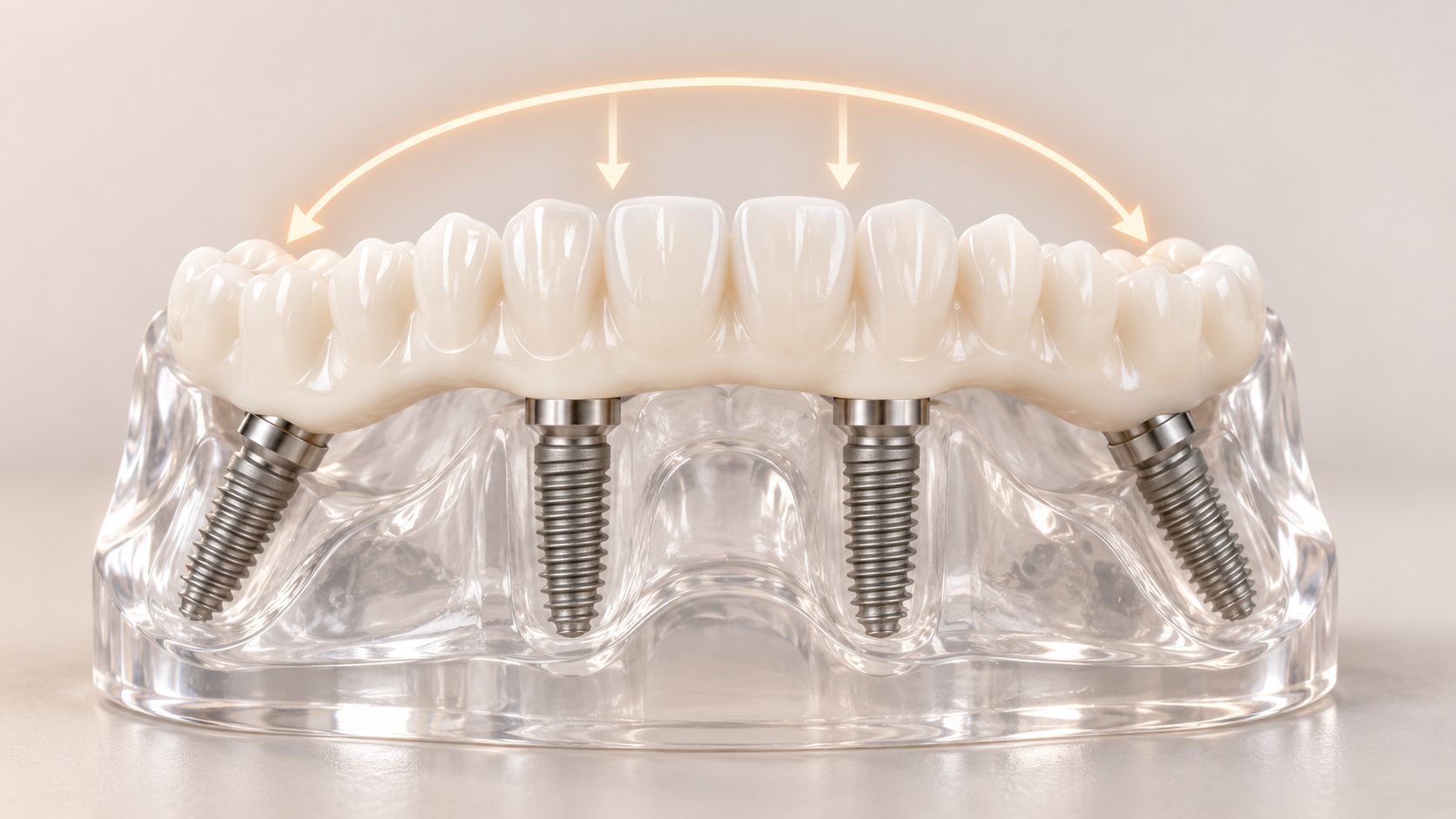
The layout row is the one that changes how surgery day feels. In a typical All-on-4, two implants sit upright near the front of the jaw and two are tilted backward, which lets the surgeon anchor into denser bone toward the front and steer clear of the sinus cavity above and the nerve canal below. All-on-6 usually spreads six posts along the arch with fewer tilted ones, so more of the jaw has to offer solid bone at each site.
Load sharing is where engineering meets reality. A three-dimensional finite-element comparison reported lower maximum principal stresses in cortical bone and implants with All-on-6, while All-on-4 produced lower stresses in trabecular bone under vertical and horizontal loading, and the authors concluded that All-on-6 had the more favorable overall biomechanical behavior. Those are modeled predictions, not outcomes measured in patients, so treat them as one input among several.
Read the last two rows together. With six implants, losing one leaves five posts that can often keep a fixed bridge in place while the site heals. With four, losing one usually means the arch can't stay fixed, and you may spend months in a removable interim while a replacement integrates. That difference in backup is the strongest practical argument for six, and it has nothing to do with which design is "stronger."
Cost direction follows the surgical count, but only in direction. Two extra sites mean more hardware and more chair time, yet the final figure depends on grafting, materials, imaging and the state of your gums. Our practice in Katy, TX plans each arch from 3D imaging before quoting anything, because a count chosen from a brochure tends to cost more later.
The one line worth remembering: the implant count is a design choice, not a quality score.
What Survival Studies Show for Each Option
Survival rates answer a narrow question: did the implant stay in place? They do not answer the question patients often mean, which is what life with the arch will look like five or ten years later.

The head-to-head comparison
A direct comparison of full-arch cases using four and six implants found no statistically significant difference in implant-level survival. The 2023 retrospective cohort study followed 217 patients who received 1,222 implants supporting 271 immediately fixed full-arch prostheses over 3 to 13 years. It included 202 All-on-4 prostheses and 69 All-on-6 prostheses, and reported no measurable survival advantage for six implants over four.
That kind of study can show patterns in real treatment, but it cannot prove that two designs are identical in every patient. It does challenge the simple claim that more implants always means a longer-lasting result. A fixed arch succeeds because the plan fits the jaw, bone, bite, gum health, and maintenance routine of the person wearing it.
What the long-range reviews show
Long-term reviews also place four- and six-implant full-arch restorations in the same broad performance conversation. A 2012 systematic review of full-arch fixed prostheses supported by four to six implants estimated maxillary prosthesis survival at 97.5% after five years and 95.0% after ten years, with mandibular survival at 97.9% and 95.9% over the same intervals.
Those figures combine implant counts, so they should be read carefully. They show that clinicians have long used both four and six implants for full-arch care with strong reported survival. They do not turn survival percentages into a ranking between the two designs.
Think of survival data like a seat-belt rating. It matters, but it does not tell you how comfortable the drive is, how often the car needs service, or how well you handle a detour. In the same way, an implant can remain stable while the bridge needs repair, a screw loosens, or the gums need treatment to stay calm.
Why a survival rate isn't a promise
Survival means the implant is still in the jaw and functioning. It says little about chipped porcelain, loose screws, cleaning difficulty, or how much upkeep the arch needs over time. A very high survival rate can still sit beside repeated repair visits if the bridge design or hygiene access makes maintenance hard.
That is why the more useful question is not, “Four or six?” It is, “What happens if one implant fails, how will the bridge be cleaned, and what repairs are likely over the years?” Those details shape the day-to-day experience of full-arch implants far more than a survival headline suggests.
Both designs can perform well when the plan is based on the patient's anatomy and goals. The clinical team reviews bone structure, gum health, restorative goals, and the practical maintenance plan before recommending an implant configuration. The long-term choice deserves attention not because one count is universally better, but because the backup plan and upkeep should be understood before surgery.
How Bone, Angles and Load Shape Your Options
Your implants don't sit in the jaw like fence posts in soil. They fuse to living bone, and every chewing stroke funnels force through them into that bone. Where the posts sit, how far apart they are and what angle they enter at decide how that force gets distributed.
Why the rear implants get tilted
Tilting the back implants does two jobs at once. It lets the surgeon reach denser bone further back without drilling into the sinus or the nerve canal, and it moves the point where the bridge exits the gum backward, which shortens the unsupported stretch behind the last implant. That overhang behaves like a diving board, levering hard against the nearest post every time you bite down. Shortening it is the whole point of the All-on-4 geometry.
Angulation matters in its own right, separate from how many implants you receive. A prospective study of immediately loaded full-arch restorations that included patients treated with either four or six implants found implant survival of 97.1% for straight implants and 96.0% for tilted implants after 12 to 36 months, with success rates of 94.3% and 94.0% and no statistically significant difference between the groups. Angle is a planning variable, not a warning sign.
When the upper jaw changes the math
The lower jaw is dense and grips implants firmly from day one. The upper jaw is softer, and the sinuses sit directly above the sites where back implants want to go. After years without teeth, those sinuses often expand downward into the bone a surgeon needs. That's why a sinus lift, which gently raises the sinus membrane and adds bone density to the upper jaw so it can support an implant, sometimes enters the conversation.
Six implants ask more of the jaw. In the upper arch, placing posts further back can mean grafting, which adds a procedure and months of healing. Four tilted implants were invented largely to solve that problem without grafting, and plenty of upper jaws still do well on four.
Which situations usually point one way
The table below is a starting map, not a verdict. A 3D scan settles what the map can only suggest, and mixed plans (four in one jaw, six in the other) are common and reasonable.
Which option usually fits each situation
| Situation | Often favors | Why it matters |
|---|---|---|
| Enough bone in the back of the upper jaw | All-on-4 or All-on-6, based on implant spacing | Straight posts may fit without grafting |
| Limited back bone that allows tilted rear implants | All-on-4 with tilted rear implants | Uses existing bone and can avoid some grafting |
| Heavy bite or teeth grinding | Often All-on-6 | Modeling suggests load is shared across more implants |
| Smoking, diabetes or gum disease history | Individualized plan, with gum treatment first | Complications are more likely, so planning and maintenance matter more |
| Lower-jaw full arch | Four or five implants often considered enough | Older guidance on lower jaws; bone quality varies |
| Hard to attend recalls or limited dexterity | Plan for maintenance access before choosing | Cleaning and repair access shape long-term results |
Two rows deserve a longer look. Heavy grinding concentrates force that a four-implant arch carries on fewer shoulders, which is where six earns real ground. Limited dexterity is the opposite kind of signal. If cleaning under a fixed bridge is hard for you, a design that's simpler to maintain beats one that's theoretically stronger. Understanding why bone health matters for successful dental implants helps you ask better questions about both.
The strongest candidate for either design has healthy gums, keeps recall appointments and cleans under the bridge daily. Anatomy decides which design; habits decide how long it lasts.
Surgery Day and Recovery for Full-Arch Implants
Here's the sequence, in the order you'll experience it.
- Comfort first. We numb the area thoroughly with local anesthesia, so most patients feel pressure or vibration rather than pain. Sedation is available if anxiety is the bigger obstacle. Any remaining teeth are removed at this stage, and implants go into the planned sites.
- A fixed provisional bridge, often within 48 hours. Immediate loading depends on firm primary stability and careful case selection. A prospective mandibular study that placed two axial and two distally tilted implants and loaded the bridge within 48 hours recorded no implant failures at the reported follow-up, producing 100% cumulative implant survival, according to the immediate-loading protocol study. That's a specific protocol and patient group, not a guarantee.
- The first week is swelling, not agony. Expect bruising and tenderness peaking around day two and easing through the first week. Ice, prescribed pain relief and a soft-food diet handle most of it. Plan on softer meals for several weeks while the implants integrate.
- Clean gently and skip the cigarettes. Follow the surgical team's instructions for cleaning around the provisional, and treat smoking as a direct threat to healing.
- Compare the two paths openly. Six implants mean more surgical sites and often longer surgery, so swelling can run a little heavier. Four means fewer sites. Neither count guarantees an easier recovery.
- Integration takes months, and the final bridge comes later. Bone grows into contact with the implant surface over roughly three to six months, and the definitive bridge is fitted after that.
Immediate teeth are provisional teeth. They look finished and they aren't. A clinical study of immediate maxillary rehabilitation with tilted implants treated 70 patients with 280 implants and reported cumulative survival of 95.7% at the patient level and 96.4% at the implant level after three years, which is a reminder that convenience and risk travel together. Timelines stretch further when grafting, a sinus lift or gum treatment is part of the plan.
Costs, Maintenance and Long-Term Upkeep
You won't find a price in this article, because a real number comes from a personal estimate and nothing else. What you can compare today is the structure of the cost.
Several things drive the total. Implant count is one. Jawbone health is another, and it's the one that surprises people, because grafting or a sinus lift adds a procedure and healing time before implants even go in. The number of missing teeth, the materials chosen (high-grade titanium or zirconia for the posts, and crowns ranging from all-metal for hidden molars to porcelain or ceramic for visible teeth), 3D imaging and any gum treatment that has to come first all move the figure. We customize every treatment plan around your anatomy, health needs and goals rather than quoting from a menu.
The upkeep side nobody quotes upfront
A systematic review of four- and six-implant configurations found minimal overall outcome differences between the two, while the complications that drive long-term expense, particularly screw loosening, bleeding on probing and marginal bone loss, stayed practically important. A five-year comparative study in the same evidence base found no statistically significant difference in implant or prosthesis outcomes, with a trend toward more technical and biological complications with All-on-4 and more implant failures with All-on-6.
Complication rates are where the two designs separate slightly, not dramatically. A recent systematic review of one-year outcomes reported pooled survival of 99.20% for All-on-4 and 100% for All-on-6, mechanical complications of 5.91% versus 6.64% and biological complications of 6.54% versus 7.41%, with the authors cautioning that high study heterogeneity limits certainty. Nobody should pick a design to chase a one-point difference in a pooled rate.
The question that changes the total
Ask what happens if one implant fails. With six, the bridge may stay fixed on five while the site heals. With four, it usually can't, and a removable interim enters the picture. Ask too whether a replacement implant is included in the quote, and whether the bridge has to come off for routine cleaning.
Compare five-year totals, not implant counts. A lower surgical count with repeated repairs can outrun a higher count with maintenance built in.
Picture two estimates. One has four implants, a graft, and no stated policy on failed-implant replacement, so every screw check and repair lands as a separate bill. The other has six implants with recall visits and a replacement provision written in. The second looks more expensive on day one and may be the cheaper arch by year five.
We offer flexible financing and occasionally run special packages to spread the cost, and the figures that matter are the ones in a written estimate that lists exactly what's included. For a closer look at the moving parts, read what affects the cost of dental implants before your consultation.
What Your Katy Implant Consultation Looks Like
The first visit is a planning appointment, not a sales pitch. You will not be asked to choose between four and six implants that day, because the scan usually makes that decision before anyone does. Here is how the visit runs and why each step exists.
- We review your history, goals and worries. Medical conditions, smoking, grinding, past gum treatment and what you really want from your smile all change the recommendation. Say the anxious part out loud here, because it shapes the sedation plan.
- We take 3D imaging. Advanced scans measure bone density, jaw structure and sinus position, which is the only reliable way to know whether six implants have somewhere to live.
- We treat gum disease first if it's present. Surgery waits until the gums are healthy, because active periodontal infection around a new implant is a fight you don't want.
- We compare All-on-4, All-on-6 and mixed plans against your scan. Sometimes the image settles the implant count before anyone expresses a preference.
- You leave with a transparent, customized estimate and financing options. A number you can plan around beats a range you have to guess at.
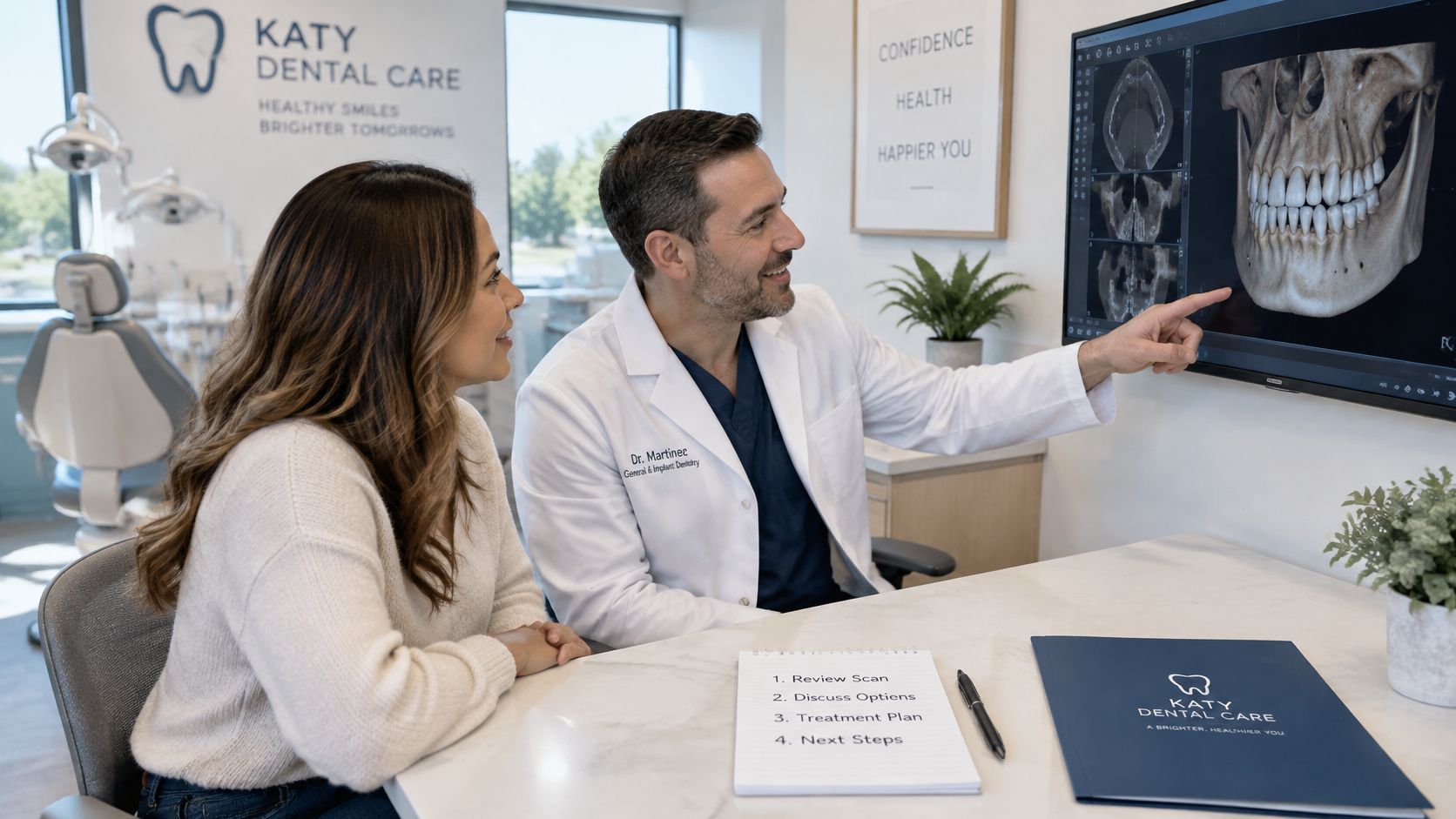
That last step matters more than most patients expect. The estimate is where maintenance and complication planning become visible: what recall visits cost, what happens if an implant fails, and whether repairs are included or billed separately. Two quotes with the same implant count can describe very different decades of upkeep, and this appointment is your chance to ask which one you are looking at.
Comfort is planned, not improvised. The office numbs the area thoroughly with local anesthesia, so most patients feel only pressure or vibration rather than pain. If a clinical setting is what usually makes you tense, the room itself helps, with aromatherapy, heated massage chairs and noise-cancelling headphones available.
Every consultation includes 3D imaging, a conversation about your goals, and a written, customized estimate you can take home and think about. Nobody has to decide anything in the chair.
Book Your Full-Arch Consultation in Katy
Bring five questions to your consultation and judge the answers, not the brochure. Does my scan show enough bone for six implants? Would tilted implants or grafting be needed, and what does that add in time and cost? What happens to my bridge if one implant fails during healing? How often will the bridge come off for cleaning or repair, and who does that? What will upkeep cost me each year?
Those answers decide more about your next decade than the implant count on a treatment flyer. An implant plan works like a maintenance map. The number of posts matters, but so does access for cleaning, a clear response if one implant fails, and a realistic view of long-term costs. A clinic that answers with reference to your own scan is planning your case. One that answers with a package name is selling you one.
Book a consultation at The Dental Retreat on Stockdick School Rd. in Katy, TX, where the team evaluates whether implants are the right fit before recommending a design. Located on Stockdick School Rd. in Katy, TX, the practice welcomes patients from Katy and the surrounding area. If you've been searching for dental implants near me and want a straight answer about four versus six, request an appointment through The Dental Retreat and bring your questions with you.
The team uses 3D imaging to create fully customized treatment plans fitted to each patient's anatomy. You'll leave with a transparent, customized estimate and financing options, so the decision stays grounded in your jaw, your goals, and the upkeep plan, not a sales pitch for more implants.